
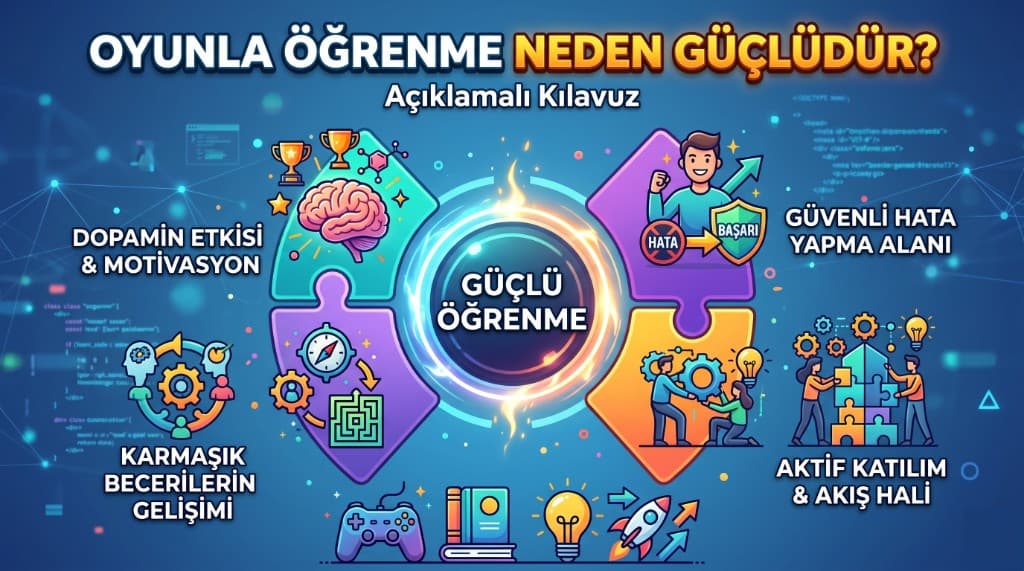
Why Play-Based Learning Is Powerful
March 18, 2026
For a long time, the world of education treated "play" and "learning" as two separate poles: play was for fun, while learning was serious work. Yet modern pedagogy and neuroscience have shown that these two concepts actually form a powerful whole.
So why is playing not just passing time, but also one of the most effective ways to learn? Here are the key reasons why play-based learning is so powerful:
1. Dopamine Effect and Motivation
Games activate the brain's reward system. Passing a level, earning a badge, or solving a difficult puzzle helps trigger dopamine release.
- Continuity: Dopamine increases the desire to keep going with the activity.
- Positive reinforcement: The learning process transforms from a boring task into an exciting journey.
2. A Safe Space for Making Mistakes
In traditional education systems, making mistakes is often tied to fear of failure. In games, however, mistakes are a natural part of the process.
- Trial and error: The learner discovers what to do differently in the next attempt.
- Stress management: When fear of failure decreases, the brain becomes more open to new information.
3. Active Participation and Flow
Reading or listening are passive actions. Playing, by contrast, requires active participation.
- Flow theory: By balancing challenge with skill level, games can trigger deep focus.
4. Development of Complex Skills
Games do not only make people memorize information; they also strengthen real-life skills:
- Critical thinking: Strategy building and problem solving.
- Collaboration: Teamwork and communication in multiplayer scenarios.
- Decision-making: Risk analysis in rapidly changing situations.
Traditional Learning vs. Play-Based Learning
| Feature | Traditional Learning | Play-Based Learning |
|---|---|---|
| Information Flow | Passive (Listening/Reading) | Active (Practice/Experience) |
| Perception of Mistakes | Punitive / Intimidating | Educational / Encouraging |
| Feedback | Delayed (Exam results) | Instant (Scores/feedback) |
| Focus | Memorization and curriculum | Curiosity and exploration |
In Summary
Play-based learning combines the natural human drives of curiosity and challenge with academic goals. It processes knowledge not only in the mind, but into long-term memory through experience.
"When children play, they are actually rehearsing life. For adults, play is one of the shortest paths to creativity and flexible thinking."
Even adding a small element of gamification to learning can improve efficiency and retention far more than expected.